Nine tabs for one tiny task
At 10:14 last Thursday, I had nine tabs open to publish one short AI note, and the part that stalled me was not the writing. It was the handoff: which draft was final, which image file matched the naming rule, which sentence had already been softened once and did not need a second edit. I was not missing intelligence. I was missing a small worker that could follow a sequence without dropping context. That is why I think agentic code will matter to ordinary office work sooner than many people in tech seem to believe.
I say that as someone who lives closer to translation and operations than to software engineering. My week is full of briefs, drafts, folders, revisions, and small publishing rules that nobody documents until something breaks. If your job still includes copying intent from one surface to another, this topic is already yours.
Better prompts cannot fix a broken handoff
Most people still approach AI as a smarter answer box. They ask for a summary, a rewrite, a subject line, a cleaner paragraph, a faster draft. I do that too. Then the invisible half of the task begins: checking the source, comparing versions, moving text into the right place, renaming files, fixing formatting, and making sure nothing important vanished on the way.
That is the trap. We keep trying to solve a workflow problem with better wording.
A non-developer office worker understands this immediately when the comparison is honest. It is the difference between asking a capable intern one good question and handing them a real piece of work with a file path, a deadline, a boundary, and a review rule. One answer can be brilliant and still leave the day fragmented. A bounded handoff can be ordinary and still save an hour.
My claim, put simply, is this: agentic code is not mainly a story about everyone becoming a programmer. It is a story about turning repeated knowledge work into delegated mini-jobs that can be checked, rerun, and improved.
Someone can disagree with that. Many do. They see agentic tooling as a niche for engineers, or as demo-stage theater, or as one more layer of complexity on top of tools that are already too noisy. I understand that reaction. I just think it misses where the first durable value will appear.
The useful part is not the code but the delegated mini-job
When I say agentic code, I do not mean a machine heroically building a product while you sleep. I mean something more modest and, in practice, more useful: a system that can inspect the working context, take limited actions, and return evidence about what it did.
That sounds technical, but the work pattern is familiar. Read the current materials first. Touch only the approved area. Follow the naming rule. Stop if a source is missing. Show the change before calling it complete. Those are not engineering fantasies. They are office instructions.
Last week I tested this difference on a small publishing routine. The plain AI version gave me a decent short summary in under a minute. I still spent another 17 minutes doing the real work around it: checking whether the wording matched yesterday’s tone, cleaning a broken line break, copying the text into the right slot, and confirming that a supporting note had not been dropped. The agent-style version was slower at the beginning because I had to specify inputs, boundaries, and the output shape. But once that instruction existed, the second run was boring. I trust boring far more than I trust dazzling.
In my own week, the difference looks like this:
| Task | Plain AI use | Agent-style handoff |
|---|---|---|
| Turn notes into a brief | “Summarize this text” | Read the note, keep only verified points, structure the brief in the house format, mark uncertainty |
| Prepare publishable files | Human copies, renames, pastes by hand | Apply the file rule, place outputs in the correct location, report anything missing |
| Review revisions | Human scans two drafts line by line | Compare version A and B, list only meaning-level changes, flag deleted claims |
The important part is not that code exists somewhere underneath. The important part is that the unit of work changes. You stop asking for isolated output and start describing a small job with context, constraints, and proof.
That change matters most in exactly the kind of work many non-developers underestimate. Translation, content operations, internal reporting, research prep, document cleanup, CRM maintenance, even meeting follow-up. These jobs are rarely hard because one sentence is difficult. They are hard because each task leaks into five other micro-tasks.
I learned this the slow way. On one early attempt, I asked an AI-assisted workflow to clean and prepare a draft, and it quietly removed a publication tag I needed later. Nothing exploded. That was the danger. Silent small errors are what make office automation feel untrustworthy. The lesson was not “never use it.” The lesson was “do not delegate without a checkpoint.”
So my working view now is blunt: the first real value of agentic code is not creative genius. It is operational discipline. It forces you to say what the system may read, what it may change, what it must not touch, and what proof it owes you at the end. Even if the agent fails, that clarification already improves the human workflow.
I do not have a clean industry dataset to prove this in a neat chart, and the public evidence is still thinner than the marketing language around it. Much of what people see right now is best-case demo material. Still, in the daily friction of actual work, the pattern is clear enough for me to take a position: the people who benefit first will often be the people closest to repeated messy coordination, not only the people writing software full-time.
Where I still keep my hands on the wheel
This does not mean every task should be delegated.
If the cost of a silent mistake is high, I keep a human review gate. I would not trust an agent on its own with final billing numbers, a legal promise in customer-facing text, or anything that moves money or publishes a claim I cannot easily retract. I also would not force agentic workflows onto work that changes shape every single time. Some jobs still need live judgment more than repeatability.
There is another limit worth saying plainly: a bad process becomes a faster bad process when you automate it. I have seen people try to escape vague working habits by adding tools on top. That usually creates a more confusing mess. If the task cannot be described in a few clear boundaries, the right move may be to simplify the task first.
So no, I am not arguing that every office worker should open a terminal tomorrow. I am arguing for a smaller, more practical shift: start noticing which parts of your week are already structured enough to become a handoff.
Build one small system before lunch
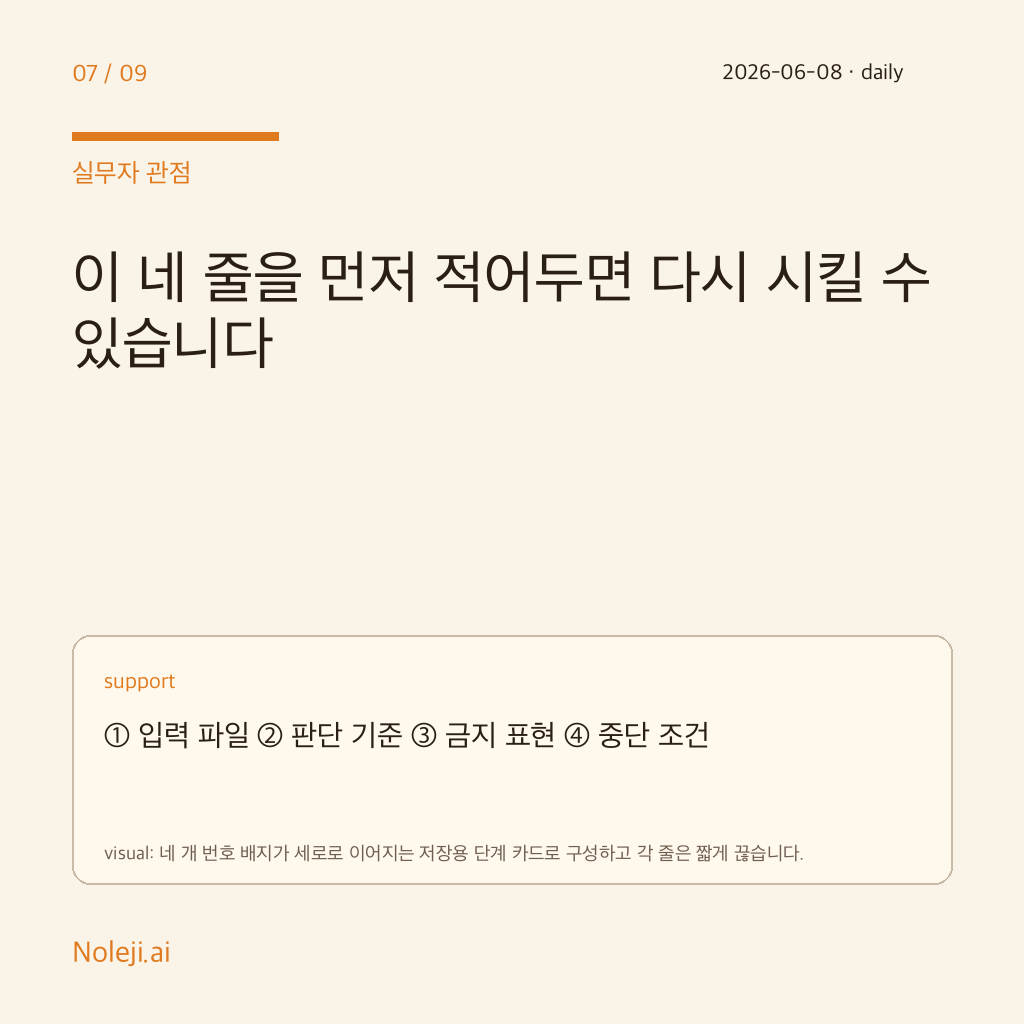
If you do one thing today, do not start by learning a framework. Start by writing down one repeated task as if you were handing it to a careful junior colleague on their first week.
① Name the task in one line: “prepare the daily brief,” “compare two drafts,” “clean the meeting notes.”
② List the exact inputs it must read before acting.
③ Define the proof you need back before you trust the result.
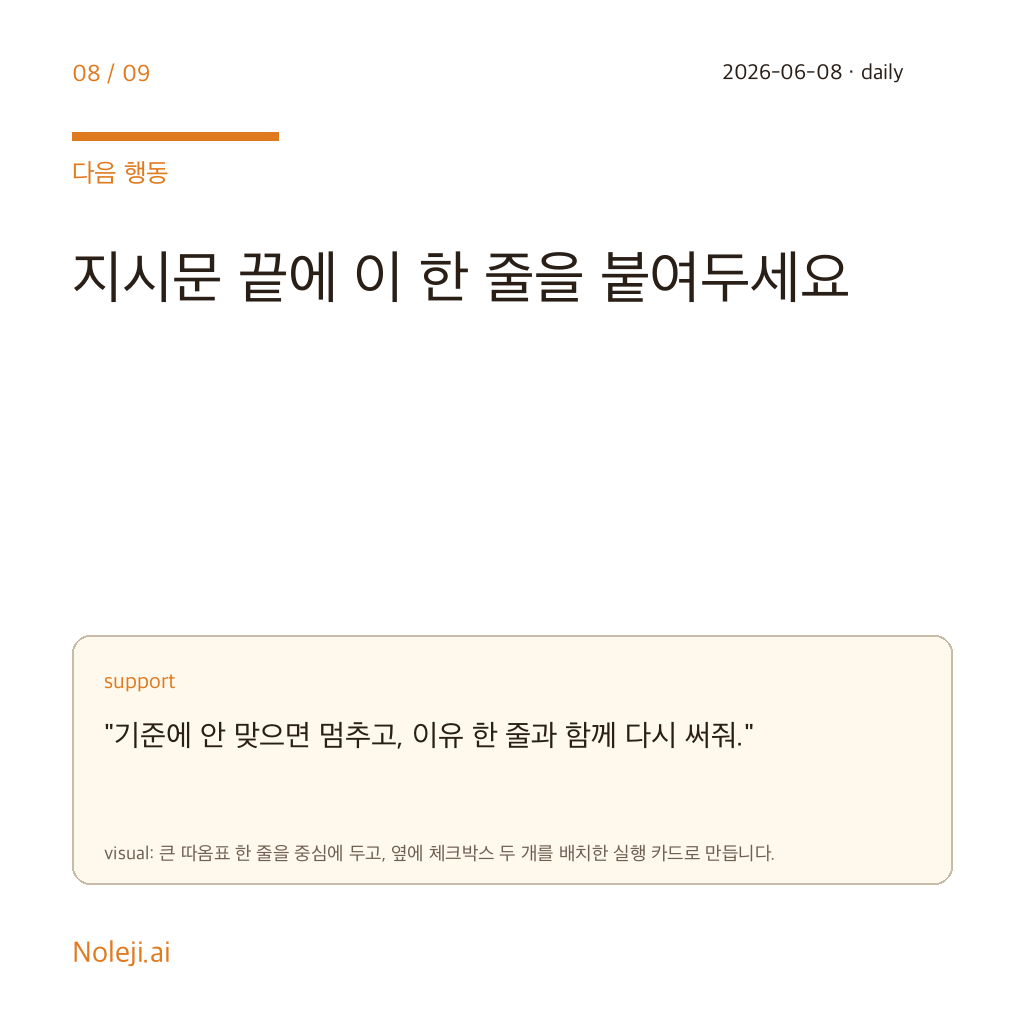
A simple line worth keeping is this:
> Read the current materials first, change only what the rule allows, and show me exactly what changed before you finish.
That sentence alone will teach you more about agentic work than ten flashy demos.
My primary suggestion is simple: pick one annoying sequence you repeat every week and rewrite it as a bounded handoff today. In the next piece, I will show how I turn that handoff into a practical working instruction for a real publishing routine without pretending the reader is an engineer.
Take-aways
- At 10:14 last Thursday, I had nine tabs open to publish one short AI note, and the part that stalled me was not the writing
- I say that as someone who lives closer to translation and operations than to software engineering
- Most people still approach AI as a smarter answer box
→ 한국어 버전 →