I trusted the polish before I checked the trail
I once treated Gemini’s clean paragraph as if it were a cleaned-up fact. That was my mistake.
The mistake was not that Gemini was useless. It was that I skipped the boring step of asking, “What can I actually trace back?”
That is the one takeaway I would keep from today’s Gemini item: for office workers, the value is not a smarter answer box. The value is a smaller, repeatable system for checking what the answer is built on.
The trap is asking for a better answer when you need a better workflow
Most people still meet Gemini the way they meet search.
They type a question. They get a neat answer. If the answer sounds reasonable, they move on.
That habit works for low-stakes tasks: rewriting a short email, cleaning up a messy memo, making a rough meeting agenda. But it fails the moment the work touches timing, policy, budget, customer promises, hiring, contracts, or anything your name will sit under.
A non-developer office worker does not need to become an AI engineer. But they do need a new reflex.
Do not ask, “Is this answer good?”
Ask, “Can I show where each important part came from?”
That sounds less exciting. It is also the difference between using AI as a shortcut and using AI as a system.
Gemini is most useful when it turns your work into checkable pieces
The attached source for today is a single Google share link related to Gemini. That is thin evidence. I would not use one shared item to make a broad claim about Google’s roadmap, model quality, or where Gemini sits against ChatGPT, Claude, or Perplexity.
But one narrow claim is fair: Gemini keeps pushing ordinary users toward a world where AI sits closer to daily work. The question is no longer whether an AI can produce text. It can. The harder question is whether the person using it can keep control of the facts, assumptions, and next action.
My thesis is this: Gemini will matter most to non-technical workers who build small verification habits, not to people who simply ask better prompts.
Someone can disagree with that. Many will say the model’s raw intelligence is what matters. I understand the argument. A stronger model makes fewer obvious mistakes and handles messier instructions. But in actual office work, I have seen the bottleneck land somewhere else.
The bottleneck is usually the handoff.
A manager asks for “a quick summary.” Gemini gives five clean bullets. The manager forwards them. Later, one bullet turns out to be based on a draft policy, not the approved policy.
A marketer asks for “three campaign angles.” Gemini gives polished language. The team likes one. Nobody checks whether the claim is backed by the current product page.
A freelancer asks Gemini to “turn this client call into a proposal.” The structure is useful. The pricing assumption is not.
None of these failures require AI to be terrible. They only require the answer to be smooth enough that the human stops checking.
That is why I prefer a simpler Gemini habit. Use it to separate the work into layers:
| What Gemini gives you | What you should ask next | Why it matters |
|---|---|---|
| A summary | “Which points came directly from the source?” | Prevents paraphrase from becoming fake certainty |
| A recommendation | “What assumptions are you making?” | Shows where the answer may not fit your situation |
| A draft email | “What claim in this email needs verification?” | Keeps confidence out of customer-facing copy |
| A comparison | “What information is missing?” | Stops a neat table from pretending to be complete |
| A plan | “What could fail first?” | Turns optimism into preparation |
This is not a productivity trick. It is a way to keep your judgment in the loop.
When I use Gemini well, I am not asking it to replace my thinking. I am asking it to make my thinking visible. The draft becomes easier to inspect. The assumptions become easier to challenge. The next step becomes easier to assign.
That is the quiet gain.
You do not need a dramatic AI transformation at work. You need a Tuesday afternoon process that makes a messy request easier to handle without creating hidden risk.
This does not work when the source material is weak or the stakes are too high
There are limits.
If the source is thin, Gemini cannot create certainty. It can only organize uncertainty. Today’s Gemini item is a good reminder of that: with only one attached Google share link, I can write about a working habit, but I should not pretend to know the full product context.
This also breaks down when the task needs professional review. Legal wording, medical decisions, financial advice, security policy, hiring compliance, and public company statements should not be treated as “AI plus a quick read.” Gemini may help prepare the material, but responsibility still sits with a qualified person.
There is another ordinary limit: your company’s data rules. If your workplace has restrictions on customer data, internal numbers, or confidential documents, the first workflow is not “paste it into Gemini.” The first workflow is learning what you are allowed to use.
AI does not remove office politics, accountability, or review chains. It only makes weak process faster.
That can help you. It can also expose you.
Try the three-column habit before your next Gemini prompt
Use Gemini today for one real work task, but do it with a small system.
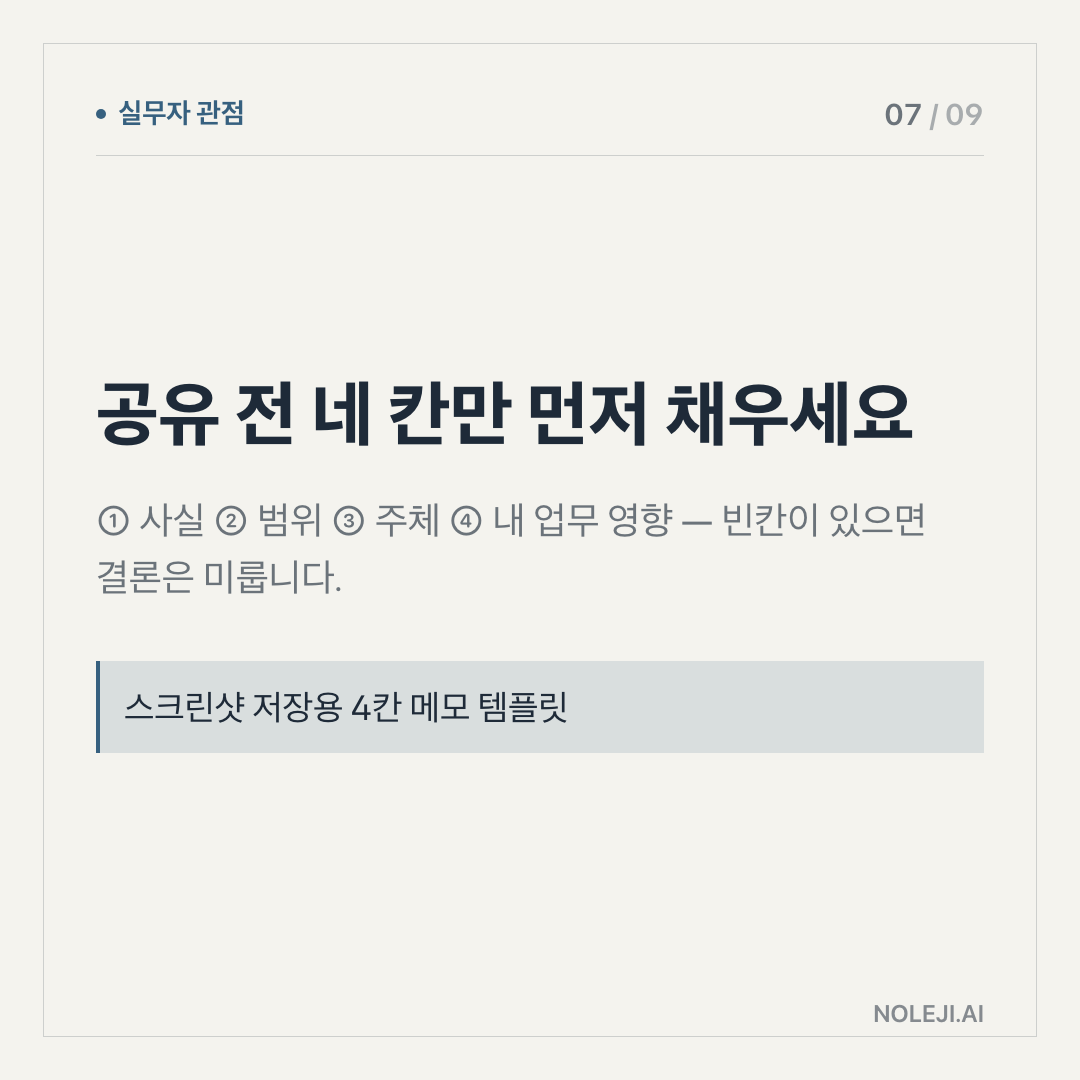
① Ask your normal question.
② Before using the answer, ask Gemini to split it into three columns: “from source,” “inference,” and “needs checking.”
③ Only act on the parts you can trace or verify.
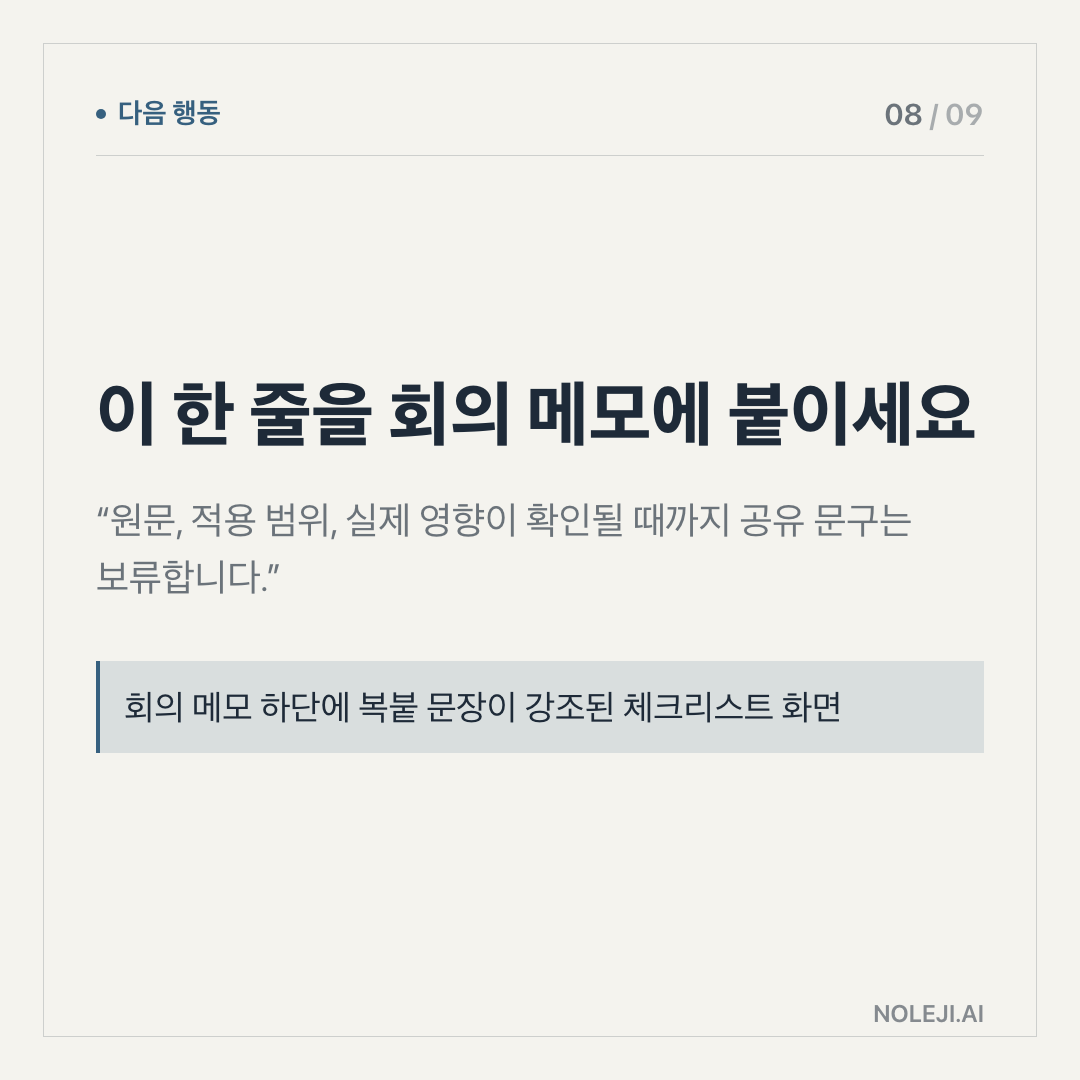
Copy-paste line:
> Before I use this, separate the answer into facts from the source, your inferences, and items I still need to verify.
That is the next step I recommend: save that one line and use it once today on a real document, email, summary, or plan.
Next edition: I’ll look at where Gemini fits better in daily work: inside your existing Google Workspace routine, or as a separate thinking tool you open only when the task gets messy.
Take-aways
- I once treated Gemini’s clean paragraph as if it were a cleaned-up fact
- The mistake was not that Gemini was useless
- That is the one takeaway I would keep from today’s Gemini item: for office workers, the value is not a smarter answer box
→ 한국어 버전 →