At 11:42 p.m., the slide deck is still open, and slide 17 is the one nobody wants to rewrite. The numbers are in the spreadsheet, the meeting notes are in a doc, and the story is trapped somewhere between them. If NotebookLM can now turn source material into usable slides, the temptation is obvious.
My argument is narrower: this matters only if you treat “NotebookLM Slides” as a work system, not as a free design shortcut.
The real pain is not making slides, it is deciding what belongs on them
I have seen this pattern too often in office work. The hard part of a presentation is rarely the rectangle on the screen. It is choosing what to leave out, what to put first, and what kind of proof the listener will trust.
That is why a slide-generation update feels bigger than another AI writing feature. A memo can hide weak thinking in paragraphs. A slide cannot. Every page forces a decision: one point, one frame, one visual hierarchy.
For non-developers, this is where AI starts to feel practical. Not “build me an app.” More like: “I have 38 pages of notes, 4 customer calls, and 25 minutes before the director asks for a deck. Help me turn this into something I can speak from.”
The common mistake is asking AI to make a beautiful deck
Most people will try the wrong prompt first.
They will ask for “a professional presentation” or “a clean 10-slide deck.” That usually produces polite, generic pages. The deck looks finished, but it does not know your meeting, your politics, your audience, or the one chart your boss will question.
I would not use NotebookLM Slides as a designer. I would use it like a junior analyst who has read the source material and can draft the first structure without complaining.
That difference matters. If you ask for beauty, you get surface. If you ask for decision support, you get leverage.
The useful workflow is source-first, not prompt-first
The title mentions 9 practical examples and 50 templates, but the source manifest for this archive does not include verifiable links or source names. So I will not pretend to confirm the exact update details. I am treating this as a workflow signal: Google is moving NotebookLM further from “summarize my sources” toward “turn my sources into usable work artifacts.”
That direction is worth watching.
NotebookLM already has one strong advantage over general chat tools: its center of gravity is the source set. You give it documents, notes, transcripts, PDFs, or research material, then ask from inside that bounded context. For slide work, that is not a small detail. It means the deck can start from what you actually know, instead of from what a model can fluently guess.
Here is the comparison I would keep near my desk:
| Work style | What you ask AI to do | What usually happens | Better use |
|---|---|---|---|
| Prompt-first slides | “Make me a deck about this topic” | Generic structure, vague claims, decorative confidence | Good only for brainstorming |
| Template-first slides | “Use this format and fill it in” | Faster layout, but weak judgment | Useful when the story is already clear |
| Source-first slides | “Use these notes and build a deck for this audience” | Better grounding, clearer tradeoffs | Best for real office work |
| Human-final slides | “Draft the structure, then I edit the argument” | Slower than full automation, but safer | Best for anything political or high-stakes |
The practical examples I would test are not fancy. They are ordinary, and that is why they matter.
① Turn meeting notes into a 5-slide decision brief ② Turn a long PDF into an executive summary deck ③ Turn customer interview notes into a problem-pattern deck ④ Turn a quarterly report into a leadership update ⑤ Turn a product spec into an internal training deck ⑥ Turn research notes into a lecture outline ⑦ Turn a policy document into an FAQ presentation ⑧ Turn scattered project updates into a weekly status deck ⑨ Turn a messy idea dump into a first investor narrative
Last week, I tried a similar source-first workflow with a rough memo and a set of meeting notes. The first output was not good enough to send. But it did something useful: it exposed the missing argument. I could see, in slide form, that I had evidence for three points and only a feeling for the fourth.
That is the value. Not “AI made my deck.” More like: “AI showed me where my thinking was still soft.”
This will fail when the room needs judgment, not formatting
There are cases where I would not trust this workflow.
If the presentation is about layoffs, pricing changes, legal risk, investor messaging, or a sensitive internal conflict, an AI-generated slide structure can flatten the emotional reality of the room. It may choose a clean sequence when the actual work requires caution, silence, or a difficult first sentence.
Templates can also become a trap. Fifty templates sound useful, but template abundance often creates template shopping. You spend 20 minutes choosing a format instead of sharpening the claim.
The safest rule is simple: let AI draft the structure, not own the position.
A slide deck is not just information. It is a social object. Someone will defend it, question it, forward it, or use it to make a decision. If your name is on the deck, the final judgment must still be yours.
Start with one repeatable deck, not fifty templates
Today, I would not build a huge template library. I would build one small slide system for work I repeat.
Pick one recurring situation: weekly update, customer insight report, project proposal, team training, or executive summary. Then make NotebookLM work inside that pattern.
Use this copy-paste prompt as a starting point:
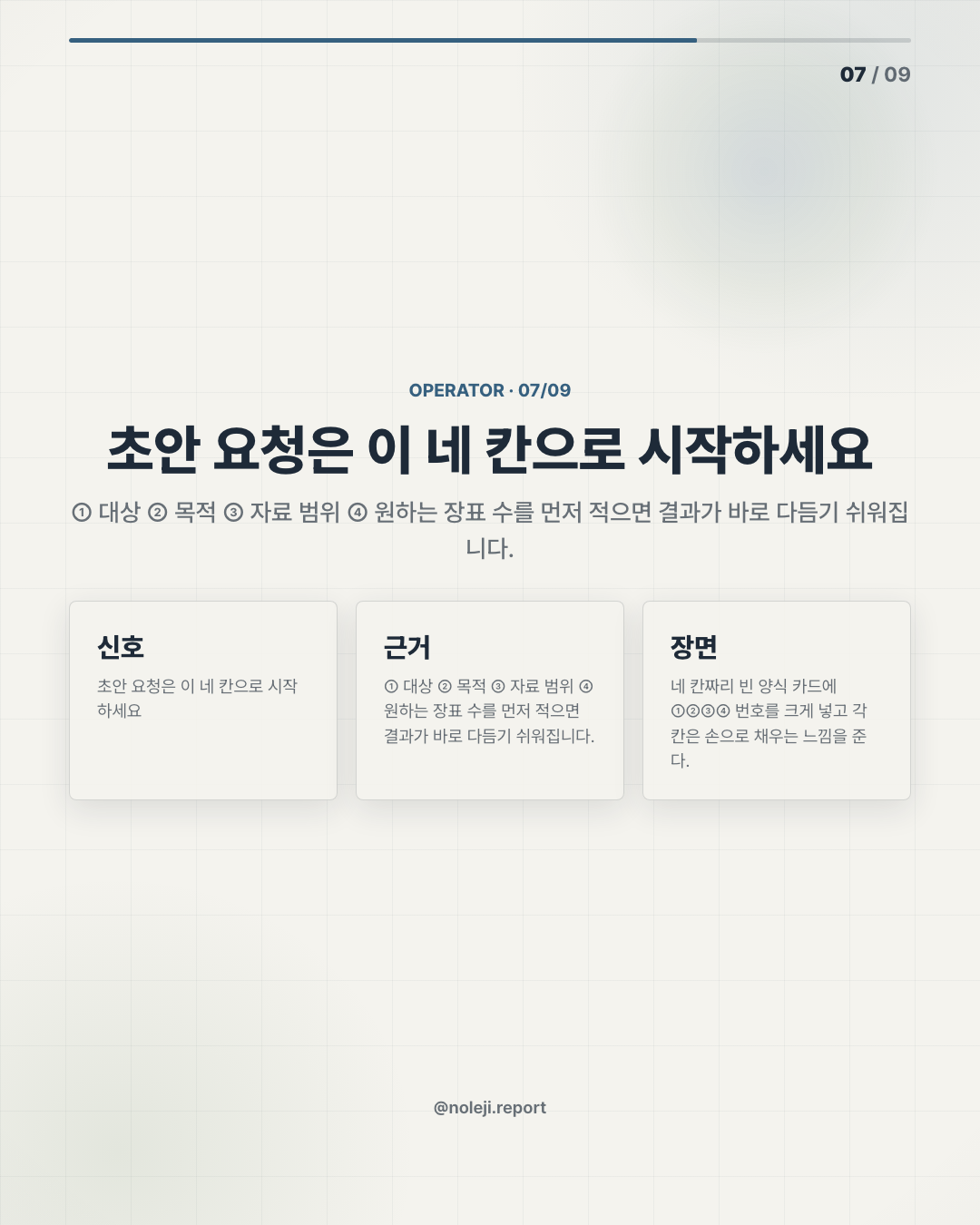
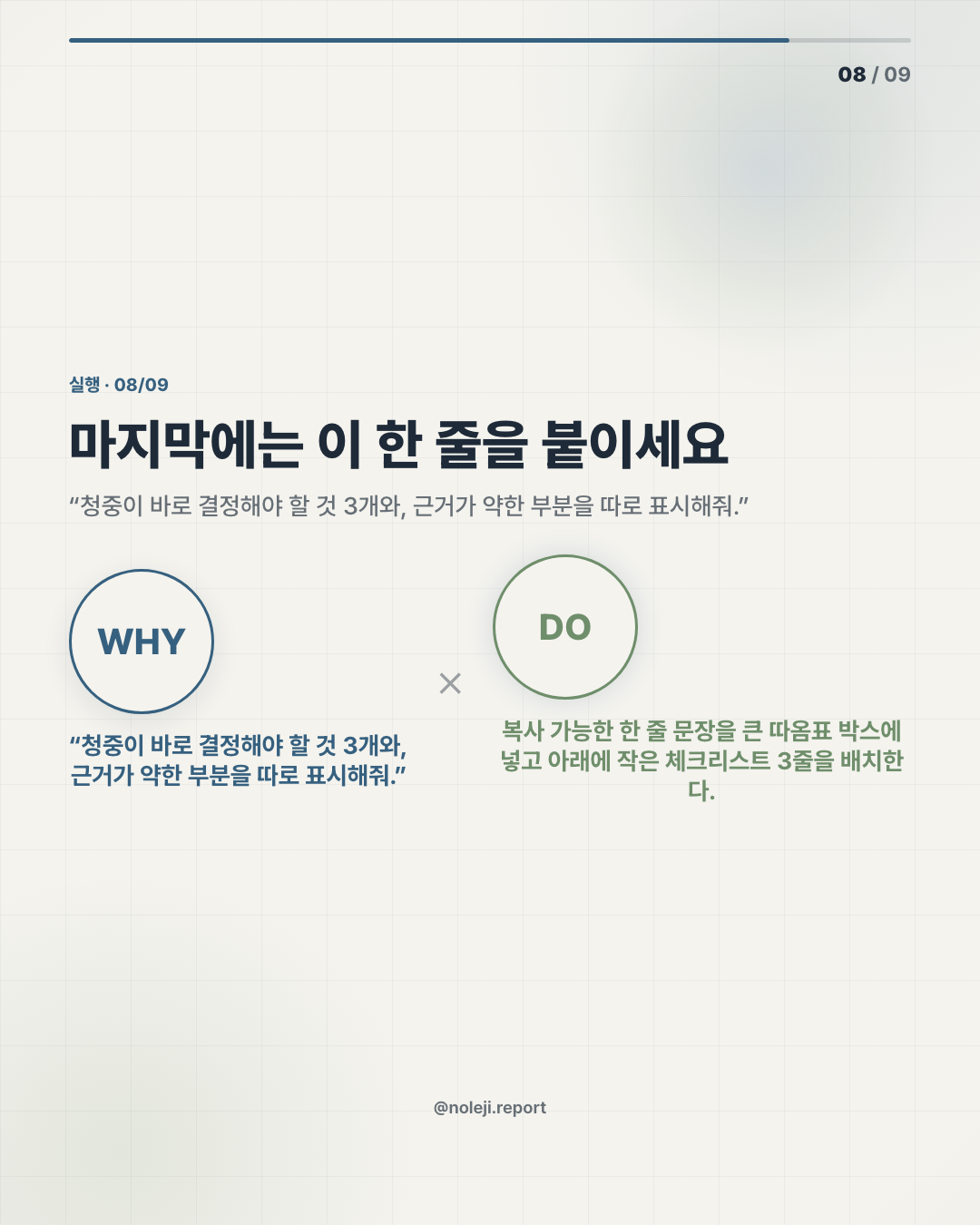
> Turn these sources into a 7-slide decision brief for a busy non-technical manager. Each slide should have one claim, the evidence behind it, and the decision or question it supports. Do not add facts that are not in the sources. Mark weak evidence clearly.
Then check the draft with this short list:
- Does every slide make one claim?
- Can I point to the source behind that claim?
- Is there one slide I would be nervous to defend?
- Did the AI hide uncertainty behind smooth wording?
- What must I rewrite in my own voice before sending?
My next step is simple: build one source-first deck workflow and use it twice before judging the tool. Not fifty templates. One repeatable system.
다음 편에서는 이 흐름을 더 구체적으로 가져가 보겠습니다: 비개발자 직장인이 NotebookLM로 “회의록 → 의사결정용 슬라이드”를 만드는 프롬프트 구조를 하나씩拆어 보겠습니다.
Take-aways
- At 11:42 p.m., the slide deck is still open, and slide 17 is the one nobody wants to rewrite
- My argument is narrower: this matters only if you treat “NotebookLM Slides” as a work system, not as a free design shortcut.
- I have seen this pattern too often in office work
→ 한국어 버전 →